From the Classroom to the Open Data Ecosystem: Reflections from Our Open Data Packages Masterclass Meetup
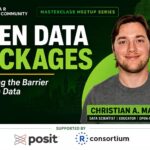
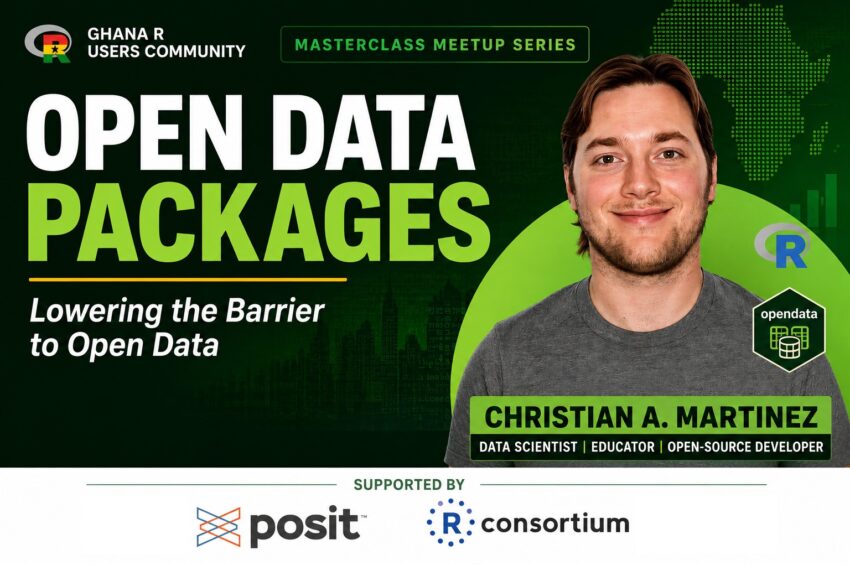
On Monday, 5 October 2026, the Ghana R Users Community hosted the Open Data Packages masterclass Meetup with Christian A. Martinez, data scientist, educator, open-source developer, and founder and director of the Open Data Lab. His session, “Lowering the Barrier to Open Data: From Classroom Problem to R Package,” asked how we can make public data easier for people to discover, access, analyse and learn from.
The topic suits where we are. Interest in R, reproducible research and open-source development is growing in Ghana, and local and public datasets need to be easier to work with.
A classroom problem
Christian began with the experience that led him into open data. While teaching R and data analysis to graduate students at Brooklyn College, he relied on familiar datasets such as mtcars. The dataset worked for demonstrating statistical concepts, but it had little to do with his students’ lives. They were in New York City, and many did not own cars or drive, so car data did not interest them.
That experience shaped a teaching principle:
“Relevance drives rigor.”
If students can connect the data they are analysing to the world around them, they are far more likely to care about the questions behind the analysis.
Finding relevance in New York City Open Data
The solution was close to home: the New York City Open Data Portal. Instead of teaching only with pre-packaged datasets, Christian began looking at the thousands of datasets the city publishes about the place his students lived and studied.
One useful example was New York City’s 311 service-request data, which records requests made by residents, including dates, agencies, complaint types and locations. The data was no longer an abstract example for learning R. It described the city around the students.
Accessing it programmatically through APIs added technical complexity, though, especially for students still learning the fundamentals of R and data analysis. That was the next problem to solve.
Building an R package for open data
Christian built an R package to make New York City Open Data easier to access directly from R. The first version had individual functions for different datasets. Over time, the approach was streamlined so users could work with the catalogue and retrieve datasets through a simpler interface.
The package was eventually reviewed and admitted into the rOpenSci community, which made it available beyond his own classroom. It had become a reusable open-source resource.
From one package to thirteen
With the infrastructure in place, Christian asked why he should stop at New York City. Many city and state governments publish public data through open data portals, and the same approach could work for them.
The project grew from one package to 13, covering open data from places including New York State, Chicago, Los Angeles, Austin, Seattle, Cincinnati, New Orleans, Connecticut, Delaware, San Francisco and Colorado. He summed it up as:
13 packages. 3 developers. One shared architecture.
The work was not done by one person. A former student created an open data package of their own, and an intern contributed packages for several locations.
Making it possible for others to contribute
Scaling the project took documentation as well as code. Christian wrote an Open Data Package Developer’s Guide with a step-by-step process and reusable code templates for building packages around Socrata-based open data portals. If a portal follows the relevant structure, someone else can use the guide and templates to build an R package without starting from scratch.
Another principle ran through the talk:
“Teach meaning first, and then teach plumbing later.”
The technical side is still taught. The unnecessary barriers are removed so people can first focus on asking useful questions and understanding the data.
What students built
Christian shared the New York City Open Data Student Gallery Book, which brings together nine independent student research projects. Each student chose a question to answer using New York City open data. Topics ranged from the relationship between restaurants and museums to mold exposure and domestic violence reports. The projects were compiled into a single publication and released as a CUNY-funded Open Educational Resource.
For Christian, this showed that accessible data is about more than downloading a CSV file. It gives people the tools to form their own questions, do research and share the result.
Dashboards and data sonification
Christian also demonstrated a live New York City 311 dashboard built with Shiny and powered by the open data package. Users can explore service requests, filter by location and date, and look at complaint types and agencies.
The dashboard can also turn the data in a graph into sound. Changing the filters changes the sound, which offers another way to experience and explore the data.
What this means for Ghana
During the Q&A, a question was raised about whether a similar approach could be used to create R packages around Ghanaian open data. Christian welcomed the idea and said he was interested in collaborating.
His broader goal is an open data ecosystem where public data portals are easier for R users to work with, so people can ask questions and find answers without unnecessary barriers between them and the data.
Ghana has public datasets and data portals that could be easier to explore through R. Packages built around them could help researchers, students, educators and analysts, and give community members a practical way to learn package development while building something useful. The conversation also touched on opportunities for young R enthusiasts and potential internships or collaborations with the Open Data Lab.
Where this leaves us
Christian’s journey began with a teacher asking why his students were not connecting with the data in front of them. It grew into an open-source project, a set of packages, student research, dashboards and developer documentation that others can build on.
For us, it raises a question: what could we build if Ghana’s open data were easier to access from R? We hope to continue that conversation.
Watch the full session
The full recording is now available on our YouTube channel. If you are interested in R, open data, reproducible research, package development or contributing to open-source projects, we encourage you to watch it.

Thank you to Christian Martinez for sharing his work and experience with the Ghana R Users Community, and to everyone who joined the discussion.